
We Watched Smart People Give Up on Video. So We Built SmartPrompter.


The reasons smart professionals stop making videos — and what we did about it.
Over the past few years, building AnswerStage, we’ve had a front-row seat to something that kept repeating itself. Smart, credible people — attorneys, financial advisors, association executives — would start making videos, show real promise, and then quietly stop.
It wasn’t a lack of ideas or expertise. It was two specific problems that kept coming up.
First, a lot of people are genuinely uncomfortable on camera — even confident, articulate professionals who speak in front of groups all the time. Second, sustaining any kind of video cadence is hard when every recording requires you to invent a fresh topic from scratch.
We built SmartPrompter to address both of those things directly.
Here’s how it works. When you sign up, you fill out a short form — your area of expertise, your LinkedIn profile, the topics you want to cover. That information drives a regular stream of suggested scripts delivered to you by email on whatever schedule works for you. Each reminder includes six scripts. Clicking any one of them automatically loads it into a built-in teleprompter, ready to record. You can read it as-is, edit it, or just use it to load your brain before speaking off the top of your head.
Once you’re done recording, SmartPrompter produces a branded, shareable video in minutes — no editing, no production backlog, no waiting on anyone else.
Most professionals who try video don’t fail dramatically — they just quietly stop. After years of watching this happen with AnswerStage customers, we built SmartPrompter to solve the two specific problems that cause it: camera discomfort and the constant pressure to invent something new to say. Here’s how it works and why we think it changes the equation.
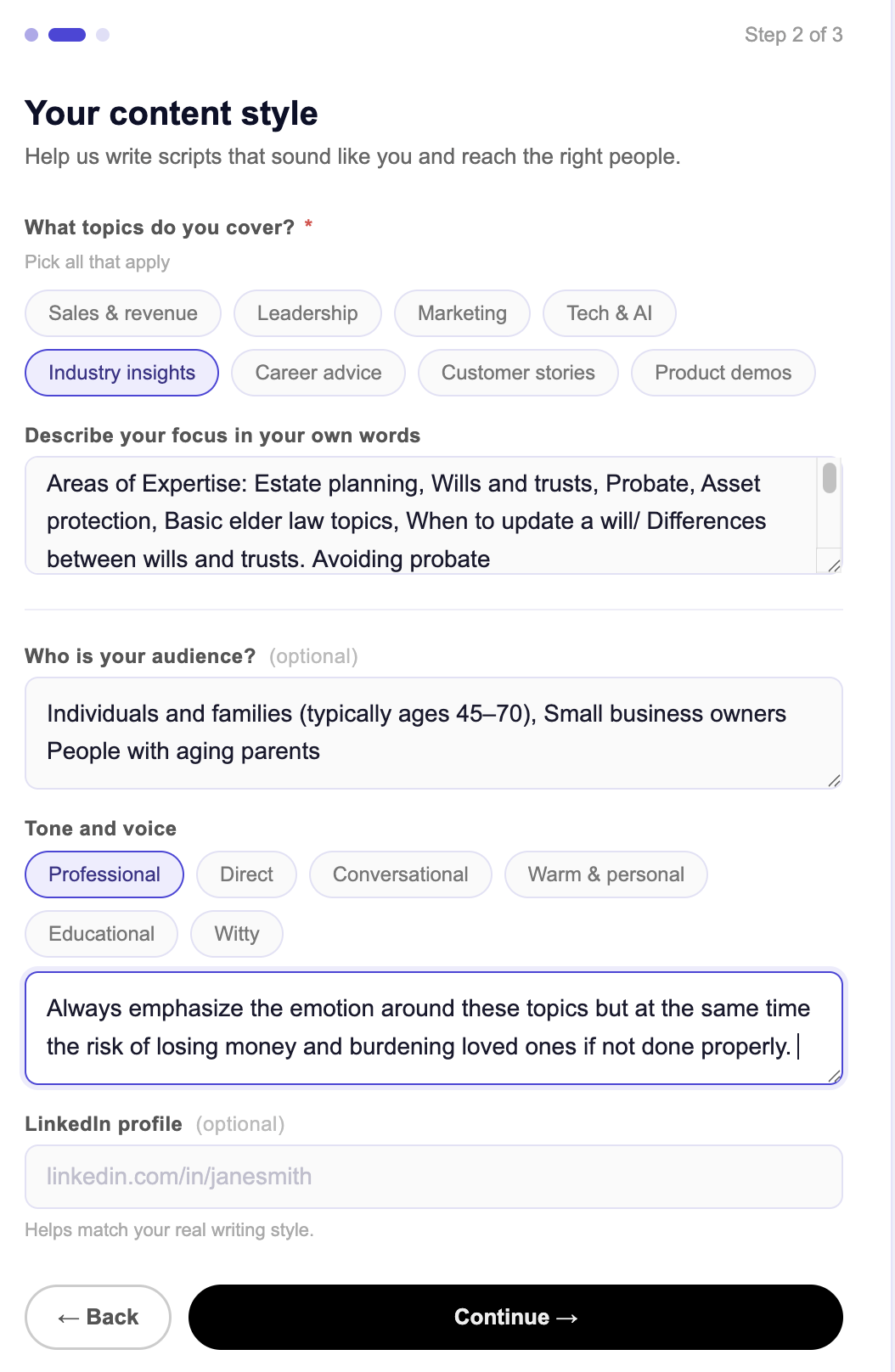
What this looks like in practice. Take an estate planning attorney. The topics their clients ask about most — when to update a will, the difference between wills and trusts, how to start the conversation with family — rarely make it into published content, not because the attorney doesn’t know the answers, but because writing it all up from scratch feels like work on top of work. SmartPrompter turns that existing knowledge into a consistent stream of videos their clients and prospects actually find useful.
The same dynamic shows up for association executives who want to stay visible with members year-round — not just at the annual conference or in the quarterly newsletter, but consistently, on the channels where their members actually spend time.
The content that tends to stand out right now isn’t highly produced or AI-generated. It’s real people addressing real topics, with personality and perspective that’s genuinely their own. SmartPrompter is built to make that kind of content easier to produce — consistently, without the planning overhead that causes most people to eventually give up.
If that sounds familiar, we’d love for you to try it. SmartPrompter is free during this introductory period — no credit card required. After the introductory period, you’ll have the option to continue with our Pro plan at $39 per month. No surprises.
Try SmartPrompter free
Addendum
Here’s what Julie’s SmartPrompter suggestion scripts look like. This is sent to her email at the intervals that she specifies. Feel free to test out the recording process. You’ll see how the script is displayed and can be edited (this is a test account so it won’t appear publicly):
Option 1
Topic: When to update your will — life events to watch for
Suggested Script:
I tell clients a will isn’t a one-and-done document — it’s a snapshot of your life at a point in time. Major life events — marriage, divorce, the birth of a grandchild, selling or buying a home, starting or selling a business, or moving to a new state — all can change who should inherit and how assets should be handled. An outdated will can leave your loved ones fighting over unclear intentions or paying unnecessary probate costs. My practical rule: review your will after any major change and at least every few years. That small habit can protect relationships and prevent your legacy from being eroded by legal surprises.
Record Here
Option 2
Topic: Wills vs. trusts: pick the right tool for your family
Suggested Script:
People often ask whether they need a trust or just a will. A will names who gets what and who will handle your estate, but most wills must go through probate — a public, sometimes costly process. A revocable trust can avoid probate, provide privacy, and coordinate incapacity planning, but it only works if you fund it — the assets must be retitled into the trust. For example, a house left in a trust can transfer to heirs without court delay; the same house in a will often triggers probate. Consider a trust if privacy, speed, or blended-family issues matter — and be sure the trust is actually funded so your family isn’t left with more work and expense.
Record Here
Option 3
Topic: Planning for incapacity — powers and healthcare directives
Suggested Script:
Planning for incapacity is as important as planning for death. If you’re temporarily or permanently unable to make decisions, the absence of a durable power of attorney or an advance healthcare directive can force your family into court to obtain guardianship — expensive, public, and emotionally draining. A durable power of attorney lets a trusted agent manage finances; an advance healthcare directive and HIPAA release let someone get medical information and make care decisions. Choose agents who know your values, have frank conversations with them, and store documents where family can access them quickly. That preparation protects your dignity and spares loved ones the stress and cost of last-minute legal battles.
Record Here
Option 4
Topic: Avoiding probate: practical steps families can take
Suggested Script:
If your goal is to spare loved ones the delay and expense of probate, start with a practical checklist: update beneficiary designations on retirement accounts and life insurance, set up transfer-on-death or payable-on-death for bank and investment accounts, consider titling real estate with rights of survivorship only when appropriate, and fund a revocable trust if you want broader probate avoidance. Be cautious: joint ownership can create tax or unintended gift issues, so don’t default into it without thinking through consequences. Inventory your accounts, confirm beneficiaries match your estate plan, and communicate your plan to the person who will be handling things. These steps reduce cost, delay, and emotional strain for your family.
Record Here
Option 5
Topic: Common estate planning mistakes I still see
Suggested Script:
I still encounter the same avoidable mistakes: outdated beneficiary designations that trump wills, DIY forms that don’t reflect your situation, trusts that were never funded, and documents that aren’t coordinated. Another common problem is choosing an executor or agent without considering temperament — legal authority is one thing, managing grieving family dynamics is another. Those mistakes produce emotional conflict and financial loss: accounts paid to the wrong person, assets tied up in court, or children arguing over unclear instructions. Simple fixes — a coordinated review, clear beneficiary check, and thoughtful choice of agents and alternates — can prevent years of family pain.
Record Here
Option 6
Topic: How to talk about estate planning with aging parents
Suggested Script:
Bringing up estate planning with aging parents can feel awkward, but it’s one of the most compassionate conversations you can have. Start from concern for their control and comfort — not money. Ask specific questions: ‘Who would you want handling your finances if you couldn’t?’ or ‘Have you thought about a healthcare proxy?’ Choose a calm moment, listen more than you talk, and offer to help organize documents rather than push changes. If emotions run high, suggest a neutral professional to explain options. Framing the talk around protecting their wishes and avoiding future family conflict makes it easier — and it spares everyone unnecessary stress and expense later on.
Record Here